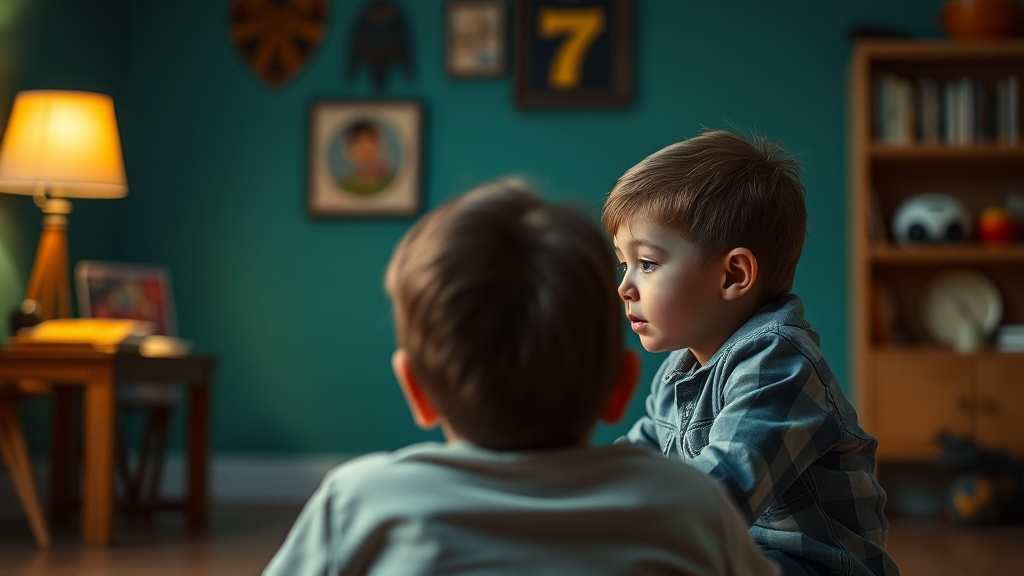
Why Won't My Kid Play Alone and Is That Even a Problem?

Why do some children resist playing by themselves?
You've finally cleared your schedule, settled onto the couch with coffee that's still warm (a rare victory), and within ninety seconds—there's a small human attached to your leg. Again. Independent play feels like parenting's holy grail—talked about in hushed, reverent tones on message boards, promised in those glossy parenting magazines, seemingly achieved by everyone else's kids at restaurants while yours climbs the booth. This post unpacks what independent play actually looks like by age, why some children struggle with it more than others, and practical ways to build those solo-play muscles without turning your living room into a battleground.
What does independent play actually look like at different ages?
Here's the thing nobody tells you: independent play doesn't mean dumping a basket of toys on the floor and expecting an hour of silence. That's a setup for disappointment—for both of you.
For toddlers (ages 1–3), independent play might last five to ten minutes. They're learning object permanence, testing cause and effect, and honestly—they just discovered you exist as a separate person. That's heavy stuff for someone who spent nine months literally inside another human. At this stage, "solo" play often means they're in the same room, occasionally glancing back to confirm you haven't vanished into another dimension.
Preschoolers (ages 3–5) can typically stretch to fifteen or twenty minutes—sometimes longer if they're deeply engrossed in something messy or forbidden. (Water play, anyone?) They're developing narrative thinking now—those elaborate stories where a plastic dinosaur is having a tea party with a wooden spoon. This is prime independent play territory, but it requires the right setup.
By early elementary (ages 5–8), most kids can sustain thirty minutes or more of focused, imaginative play—but here's the catch. They need practice. And many modern kids aren't getting it. Between scheduled activities, screens, and hovering adults ready to entertain at the first sign of boredom, their solo-play muscles have atrophied.
Is it normal for my child to want constant interaction?
Short answer: usually, yes. Longer answer: it depends on temperament, attachment style, and—let's be honest—what we've inadvertently taught them about entertainment.
Some children are wired for connection. Highly sensitive kids, extroverts, and those with anxious attachment styles often genuinely need more proximity to feel secure. This isn't manipulation or bad parenting—it's neurology. Their brains are literally seeking co-regulation, and that takes energy they don't yet possess internally.
But here's where we parents sometimes shoot ourselves in the foot. When every moment of "I'm bored" is met with a curated Pinterest activity, when we jump in to narrate their play or redirect them the instant they drift toward us, we send an unconscious message: Your entertainment is my job. It's well-intentioned—we love them, we want them stimulated, we're terrified of the "disengaged parent" label. But we're accidentally creating a dependency that's exhausting for everyone.
The American Academy of Pediatrics notes that unstructured play is critical for brain development—it builds executive function, emotional regulation, and creativity. Yet many children are getting less of it than previous generations.
How can I encourage my child to play independently without a power struggle?
Transitioning to more independent play isn't about shutting the door and hoping for the best. That's a recipe for anxiety and, frankly, creative door-pounding soundtracks.
Start with "together but separate" time. Sit in the same room with your own activity—reading, folding laundry, working on a laptop. Your physical presence provides the security they need while your divided attention models that adults have their own pursuits too. Gradually increase the physical distance as their comfort grows.
Create an invitation to play. Dumping toys in a bin is overwhelming. Setting up a specific scene—a few animals near a block "cave," dolls ready for a tea party, cars at the top of a cardboard ramp—gives them an entry point. It's like leaving a book open to an interesting page instead of handing them a closed cover and saying "read something."
Rotate toys aggressively. Less is genuinely more. When children have access to everything all the time, nothing feels special. Box up 70% of the toys, rotate them every few weeks, and watch what happens to engagement. The Zero to Three organization emphasizes that limited choices actually support deeper, more creative play.
Resist the rescue. When they inevitably drift over with that universal whine—"I'm bored, play with me"—try responding with curiosity instead of compliance. "Hmm, that doll looks lonely" or "I wonder what would happen if..." Then return to your activity. You're not abandoning them; you're trusting them.
What if my child genuinely seems unable to play alone?
Sometimes the resistance runs deeper than habit. Children processing big transitions—new sibling, divorce, starting school, moving—often regress in their ability to self-entertain. They're using proximity to you as an emotional anchor, and that's developmentally appropriate.
Watch for patterns. Can they focus when you're present but not interacting? Do they play independently at school or other people's houses? If the difficulty is situational, it's likely about attachment needs rather than attention deficits.
However, if your child genuinely cannot sustain any independent activity, becomes distressed when you step away, or shows signs of excessive anxiety across multiple settings, it's worth a conversation with your pediatrician. The CDC provides resources on recognizing when behavioral patterns may warrant professional support.
Does screen time affect my child's ability to play independently?
We can't discuss independent play without addressing the elephant in the room—or rather, the tablet in the charging station. Screens aren't villains, but they do rewire reward pathways in ways that can make self-directed play feel boring by comparison.
The constant stimulation of well-designed children's media sets an expectation that entertainment should be fast, loud, and externally driven. When that's the baseline, quietly moving plastic dinosaurs around a carpet feels like watching paint dry. The brain has been trained for dopamine hits, not imaginative labor.
This doesn't mean banning screens—pragmatically, that's not happening in most homes, and guilt helps no one. But consider the timing. Morning screen time often sabotages the entire day's play potential. Saving screens for when you genuinely need a break (hello, dinner prep) preserves those precious morning hours when children are freshest and most creative.
Also worth examining: what's filling the silence? Many adults (myself included) have forgotten how to be still. If we're constantly checking phones, streaming podcasts, or filling every quiet moment, we're modeling that stillness is uncomfortable. Children absorb this. Sometimes the most powerful thing we can do is sit with our own boredom—read a physical book, stare out a window, engage in a hobby that doesn't involve a charger. Show them that being alone with your thoughts isn't punishment. It's where ideas are born.
Building independent play isn't a switch you flip. It's a slow cultivation of trust—your trust in them, their trust that you'll return, everyone's trust that quiet moments hold value. Some days will flow. Others will feel like you're living inside a very small, very loud velcro factory. Both are normal. Keep showing up, keep creating the conditions, and trust the process. The kid who once couldn't be in a different room from you will eventually—probably when you're desperate for a hug—close their door and ask not to be disturbed. Circle of life.